Showing posts with label steel. Show all posts

Sunday, April 11, 2010

Bender's Head - eye shroud

The fiddliest bit of the project - the shroud which goes around Bender's eyes.
I first planned on building this part using slices of extinguisher and simply flattening the round section onto a mold/pattern/former, and then cutting and welding it on - sounded good in theory, but nearly impossible to do in practice without resorting to heavy equipment, or forging temperatures. - sorry no photos of that attempt - all evidence was taken to the tip months ago.

The second (and successful) attempt was to use a "built up" approach. I split some of the pipe I used for the arms and legs longitudinally, and inserted pieces of sheet in between the pipe halves to form up the shroud. In the photo below the two halves of a shroud are seen on the left, and a completed shroud on the right.

I didn't bother making the sheet the same length as the pipe halves since I knew the pipe had to go back to the centre line of Bender's head, where as the sheet did not. In the next photo the marking for the intersection with the head has been marked with a cheap whiteboard marker. (I grab the cheap ones whenever the discount store is in town - I use them for marking metal if I need to have contrast, or the ability to erase the lines (if on smooth metal) - I basically use whiteboard markers like chalk on rusty metal, or prussian blue on smooth. - I do use chalk as well, just whatever suits, or is within reach at the time)

The waste material is cut away, and the shrouds are ready for fitting to the heads.

A sharp observer will notice I have not cut the corners at the back of the shroud too accurately, and have instead commenced thinning the metal from the inside. Knowing the pipe has wall thickness of around 4mm (just under 3/16"), it knew a smooth transition would require the metal to be thinned considerably.

Fitting the shroud to the heads was fairly straightforward. I attached an eye-plate to the head, and then labeled one head "A", and the other "B". I then marked each shroud with a corresponding letter, and marked the top surface of the shroud so the shroud would always be placed on the same head, the same way up. I then worked around the seam touching up grinding, thinning, and contouring until the fit was less than 1mm (~1/16"). I also marked the head so the indestructible red paint could be ground away for the welding.

A note about the red paint... I don't know what NuSwift used, but that paint is amazing. It prevented rust for over 20 years, is hard to remove, and doesn't burn very well. In the welding photos a margin of only 1/2" can be seen between the weld, and the unburnt paint. I weld salvaged material a lot, and the epoxy paints favoured by local industry burns to a margin of at least 1" when I weld comparable thickness metals. The interior of the extinguishers had another paint inside which was pretty good at well... a thin grey paint which was found failed in only 3 of the 40 extinguishers I cut open.

Back to fitting the shrouds on...
Once fitted, the shrouds were welded in place (see photo below), and I then ground and rewelded to try and build a neat consistent fillet.
The fillet is just visible in the photo below. I placed the eyes on the plate, and bolted it in for testing the fit and look - perfect!!


The next thing to do was the liberal application of bog (automotive body putty - "bondo"), and a lot of sanding and general clean up of welds, fits, and general appearance.
I didn't take photos since the amount of dust generated from the process coated everything with a lovely dust, and I didn't want the camera filled with it.
My approach to the preparation for painting was to sand back all rust, and paint, and then apply a skim coat of bog, and then sand back so the surface was smooth. I predominantly used a flap wheel on my grinder for the aggressive work, and used files, knives, and sandpaper for the finer work.

Looking back, I know I missed a few spots here and there - I'll be the first to admit I simply wanted to get this project finished, and weighed the effort for perfection, versus the return on my time. As I said a few times to people, "it's a lawn ornament, not a show piece. I can always go back and strip him back to metal and refinish him if I change my mind."

Next article... painting. I'll discuss the colours I used, and masking the "fiddly bits"

Friday, April 9, 2010

Bender's Arms


The arms were made from the same size pipe as the legs, but needed a significantly more aggressive curve coming out from the shoulder. I marked up the 12,2,and 10 o'clock line as I did with the legs, but placed the cut lines closer in the are with the tightest curve. When I cut the 300 degree segments, I cut them wider by using the 2.5mm wheel, and making distinct V cuts, instead of simple straight cuts. The cut, but not bent, arms are shown on the welding table.


The welding table will be the subject of a page in the future, I'm rather pleased with how it turned out.


A closeup of the cuts showing the V cuts in the 300 degree segment. As I bent the pipe I had to tweak these cuts here and there to get the tighter curve for the upper arm.

As with the legs, I omitted to photograph the welding process, but it basically was grind out the cuts to remove the surface rust, then weld the cuts closed, and fill the open cut on the 60 degree segment cuts. The welded arms are seen laying on the ground in the last photo in the legs pages.

Now to make the shoulder/arm joints...

These shapes were made in the 4mm sheet I'd used everywhere else. The one on the left is the ellipse shape to match the arm pipe when cut at 45 degrees, the one on the right was welded into the shoulder joint (see the body page for this). The central bolt will be used for retaining the arm, and the smaller bolt will engage with one of the eight radial holes to lock the arm in one of eight positions. The photo shows the nuts I used to hold the bolt heads in place until they were welded in place from the back.

The above photo shows the ellipse plate welded to the arm pipe. I cut the arm at 45 degrees and then tack-welded the ellipse plate in place before grinding the closer fit, and then finishing the weld.
How did I mark the 45 degree cut on a the curved pipe? - A trick I read about used by blacksmiths was employed. I filled one of the quench buckets near the door with water to the brim, then carefully laid the pipe into the surface of the water so the waterline would mark the 45 degree line. Then I removed the pipe and highlighted the line with engineer's chalk. - The original blacksmith trick used coal dust floating on the water's surface to mark the line, but the rust on the pipe showed the line for me.

The "nut" on the central bolt was whipped up by welding a short length of 3/4" pipe to the nut, and then slotting the end for a scrap of sheet. A few tack welds and I have a long-reach wing-nut.
The photo below shows the wing-nut being used from inside the body to hold the arm in place at the shoulder joint.


A progress photo of the arms and legs attached. The arms were later shortened since I had deliberately made them longer than needed until I finalised the design for Bender's hands.


Next... Grabby and Squeezy - a.k.a Bender's hands

Thursday, April 8, 2010

Designing the model of Bender


As I mentioned at the beginning, I was initially inspired to build a model of Bender when sitting at the front step one day, gazing tired at some of the scrap metal, and noticed a familiar shape. I sat there for several minutes looking at the top half of a fire extinguisher which was being used to cover the valve of a propane cylinder - the domed top, the straight sided extinguisher, and the rounded top of the propane cylinder looked familiar, but I couldn't place it. It was the head and shoulders of Bender.
I'd admired the work done by Simon Jansen at http://asciimation.co.nz/bender/index.html, and knew I'd never have the spare time to build what he had, but after seeing the shapes in my own scrap metal, I started making plans.
I collected a few images off the web - copies shown here - if there's a copyright issue - sorry - they're images found by Googling, and used them as a starting point.

These side and front view images were found somewhere - I believe a fan had done up a 3D model of Bender and rendered these based on that.
I sat down with my own models (a diecast model, and one of the tin walking models) and recorded every dimension possible. I then built up a spread sheet of these dimensions, and scaled them to suit the diameter of a propane cylinder, and a NuSwift DCP fire extinguisher. The NuSwift has an outside diameter of 187mm. All dimensions were scaled to the relevant sizes, and recorded. As you can appreciate, there was some range in the eventual sizes, so these were tweaked based on pipe sizing, and "how it looked".


This is a photo of the "plans" I used when working on Bender. All dimensions have ranges on them, and there are small notes to myself here and there about things I expected to have problems with. Not shown are the other 16 pages of notes, designs (rejected, or used) and other ideas I had whilst doing the design.

For the construction notes in this blog (still getting used to that word... I think I'll betray my age by calling this a website, with pages) will be broken into the following pages;
Body, Base/Feet/Legs, Arms, Hands, Head, Eyes (good and failures), Antenna, Progress shots, Painting, Assembly, and then I'll do the Accessories and a few more finished shots.

Building Bender's body - part 1

Bear with me, I'm still learning how to use these blog tools. Building the body started with cutting up this damaged/condemned 44Kg (100lb) propane cylinder. If you look closely, you can see the neck ring is damaged, and the valve has been removed. I had let it sit vented for over 6 months for another project, but that project got shelved so it was donated to this cause.
After cutting away the rounded top (to become the top of Bender's shoulders), the next step was to mark out the cuts based on the amount of taper I wanted in the body. Thankfully the length of Bender's body worked out to be 6mm (1/4") above the welded seam. I then calculated the reduction in circumference at the waist, compared to the shoulders, and split it evenly on each side of the two side seams. I also calculated the minor changes in level of the top cut, compared to the tapered body once the two halves would be joined - this resulted in a 5mm (3/16") sliver being cut at the top edges tapering to nil at right angles to the side seams. The 1mm sliver at the base was ignored until welding the floor in.

The removed pieces were cut out first...


and then I commenced cutting around the bottom of the body. I cut in this order to keep the panels attached to the rest of the cylinder for stability - I hate it when steel moves around whilst being cut. The flat red dome piece on the ground is the removed top section - the red paint is probably overspray from something else... I used the cylinder for holding up things being painted for months until I cut into it.

The two panels butted up against each other on the welding cart. From the top (Bender's shoulders) the two panels form a circle with the same diameter as the removed top piece. At the bottom (facing up in this photo) - Bender's waist - the two panels form a pointed ellipse shape due to the intersecting circle segments. Making this round was quite a chore.

Tuesday, April 6, 2010

Bender is finally finished

What started with a "that's a funny look" at a 45kG (100lb) propane cylinder, with half a fire extinguisher perched on top (to keep the wasps out of the valve) has finally reached completion.

I was originally inspired by the bender brewing project at asciimation.co.nz.. but figured that my Bender would have to be metal. Since I didn't have any "40%iron, 40%titanium,etc,etc" alloys, I used the propane cylinder, old 9Kg (20lb) DCP extinguishers, pipe, and other bits and pieces to create this:

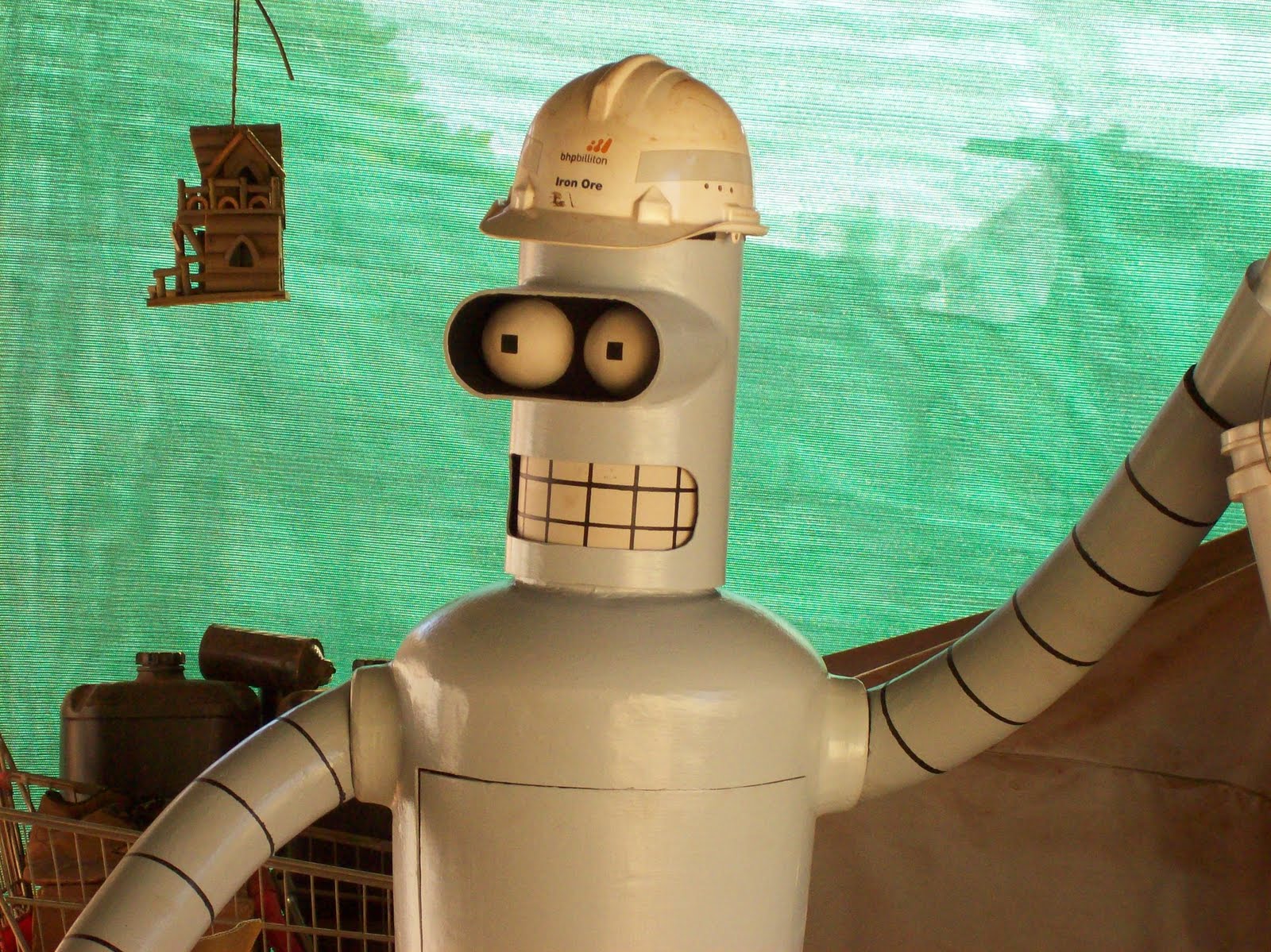
He stands 1600mm (5' 4") tall to the top of his antenna, and weighs 50Kg (110lb). His head rotates, the expression is changeable, and his arms can be moved at the shoulder joint, and the wrist.

I'll post a few more "finished" pics, and then go back and document some of the construction photos, techniques, and mistakes (I think my do-overs covered half the model)


I made two heads since I expected it to be difficult, and wanted a spare in case I screwed up badly. Thank fully most of my screwups weren't on the head, so I ended up with a spare head. Since I don't have a head in a jar for the photos, I used the spare head - after all we all know Bender enjoys his own company...
The spare head is currently being used for a bookshelf ornament, and is quite a conversation starter once people notice it.
Over the next month (work permitting), I'll finish the spare teeth panels, cigar, robotology symbol, and various eyelids to extend the range of emotions and looks he can have.

The construction photos will include some dimensions, tips, pointers, and oops.

Don't let the helmet fool you, he's not an employee of BHPBilliton Iron Ore - it's just one of the things I picked up off the side of the road when I collected the old fire extinguishers.